
A Christmas plan your child can see
A plan your child can see is a row of pictures for the day: first, then, later. Keep it to a few big things, add a "maybe" card for anything not certain, and keep a "change" card ready for when plans move. Put it where they can check it whenever they like.
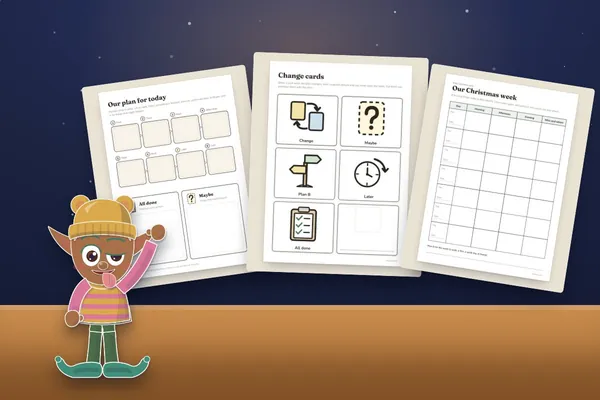
Why a plan you can see
Over Christmas, every day can be different from the one before: a visit, a show, a day at home in pyjamas (pajamas), relatives staying over. Plenty of children like to know what is coming, and a plan they can look at answers "what are we doing today?" without anyone having to remember.
It is useful for grown-ups too. When the plan is on the fridge, everyone is working from the same one.
How to make one
- Pictures, not times. A picture of the car, then Grandma's house, then dinner. Times can come later, if your child likes them.
- First, then, later. Three words that do a lot. "First the walk, then lunch, later the film."
- A "maybe" card. For anything that might not happen, like snow, a visitor who might come, or a trip that depends on the weather.
- A "change" card. Kept to one side and used when something moves. More on that below.
- Their own pictures. Photos of the real places and people can work better than drawings. Let your child pick or draw some.
How much to plan
A few big things a day is plenty. Leave gaps: unplanned time is part of the plan, and it gives everyone room to rest or play. You don't need to plan every hour, and you can stop planning any day it isn't needed.
When plans change
- Show the change card first, so the change has its own picture.
- Swap the picture on the plan together, if your child wants to.
- Say what stays the same: "We're still having lunch at home, and the film is still later."
- Give it a moment. Some children want to talk about it, some want to look at the new plan quietly.
A worked example: Christmas Eve to Boxing Day
| Day | First | Then | Later |
|---|---|---|---|
| Christmas Eve | A walk | Lunch at home | Stockings out, then bed |
| Christmas Day | Stockings | Presents, a few at a time | Dinner, then a quiet film |
| Boxing Day | Pyjama morning | Visit to cousins (maybe card) | Home, bath, bed |
In Australia and New Zealand the same plan might be a morning swim, a barbecue and a late, hot evening. In the US the season often starts at Thanksgiving, so a plan can run from then.
Where to find more
These charities share ideas for family life, and some have people you can talk to.
- UK: National Autistic Society, Action for Children, Family Action
- Ireland: AsIAm
- Australia: Raising Children Network
- New Zealand: Autism New Zealand
To print and to use
Free to print, no email
On your phone
What if they get upset when the plan changes?
That is understandable: a change is a lot when you were expecting something else. Show the change card, say what stays the same, and give them time. Some children like to move the pictures themselves.
Should I plan every hour?
No. A few big things a day, with gaps, is usually enough. Plan in more detail only if your child likes it.
My child doesn't like plans. Is that OK?
Yes. Some children prefer to go with the flow. A plan is one option among many, and you can keep one for grown-ups only.
Can I use photos instead of pictures?
Yes. Photos of the real places and people often work well. A plan can mix photos, drawings and words.
More for when Christmas is a lot
- Christmas Day, one step at a time
- Waiting for Christmas: countdowns that help
- A quiet space and a break card
- When Christmas is a lot
- All help pages
Elf Letters and more
A few emails a week until Christmas, with ideas, tips, printables and news, and one the day the app is out. Then the odd one through the year.
If that address is right, a confirmation email is on its way. Tap the link in it and everything is yours.
Sorry, our emails aren't open in your country yet.
The free printables don't need an email: get them here.
This page comes from our own Christmases, ideas other families have shared and the charities listed above. General information, not medical advice: for questions about your child's health or development, talk to your GP or family doctor, or one of the charities above.