
December at school: shows, parties and jumper days
December at school is full of changes: new timetables, rehearsals, non-uniform days, parties and a last day that ends early. Ask school for the plan as early as you can, share it with your child, and send the teacher a short note if anything would be useful for them to know.
What changes
- The timetable: rehearsals and assemblies move lessons about.
- Clothes: non-uniform days, Christmas jumper (sweater) days, costumes.
- The room: decorations, music, a different seat in the hall.
- Parties, a visit from Santa, a Christmas lunch.
- The last day: often a shorter day, and then the holidays start.
Asking school for the plan
Teachers usually know the dates of the show, the party and the special days well ahead. Ask for them in one list, then put them on your child's plan at home, with a picture for each.
The nativity or show
- Practise at home, if your child wants to: the song, where to stand, how to walk on and off.
- Ask whether there is a part that suits them. Narrator, a non-speaking role, helping backstage and working the lights are all parts.
- Watching from the side, or joining for the songs only, is fine too.
- Tell them where you will be sitting, so they know where to look.
Party days
A party at school is loud and different. Knowing what happens (games, food, a film, music) is a good start. A quieter job, like handing out plates, can be a way in. If your child would rather skip it, ask the teacher what else is possible.
The last day and the holidays starting
The last day often finishes early, and then everything changes at once. A plan for the first few days of the holidays makes the change less sudden: a plan your child can see.
A message for a teacher
A message you can copy
Hello, could you let us know the dates of the show, the party and any non-uniform days? We like to put them on our plan at home so there are no surprises. Thank you!
A message you can copy
Hi, just to let you know: they would rather have a part with fewer lines in the show this year, or help backstage. Happy to chat if that is useful. Thanks so much.
Outside the UK and Ireland
In the US, this is the season of holiday concerts and the last week before winter break. In Australia and New Zealand, December is the end of the school year: presentations, goodbyes to a teacher, and sometimes a new school after the summer, so the plan may stretch to the start of the new year.
Where to find more
These charities share ideas for family life, and some have people you can talk to.
- UK: National Autistic Society, Action for Children, Family Action
- Ireland: AsIAm
- Australia: Raising Children Network
- New Zealand: Autism New Zealand
To print and to use
Free to print, no email
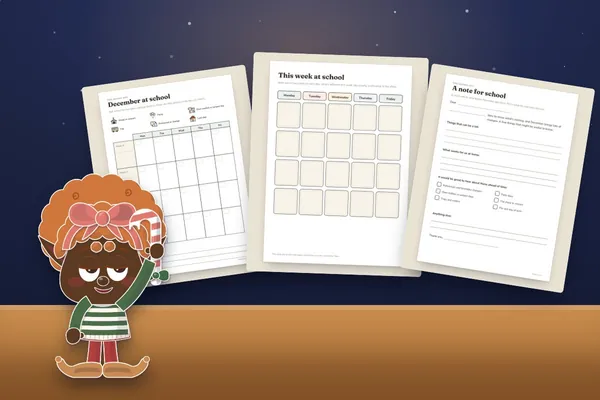
- School December planner (for grown-ups)
- "This week at school" picture strip
- A note-to-teacher template
When should I ask school for the December plan?
As early as you can, often in November. Teachers usually know the main dates well ahead.
Does my child have to be in the nativity?
Ask the school. Many have parts away from the front, like narrator, lights or helping backstage, and watching is fine too.
What about Christmas jumper day?
Any soft jumper or top counts. A Christmas badge or a hat on a favourite top can work for children who prefer their usual clothes.
More for when Christmas is a lot
- What to expect: grottos, nativities, pantos and light trails
- A Christmas plan your child can see
- Waiting for Christmas: countdowns that help
- When Christmas is a lot
- All help pages
Elf Letters and more
A few emails a week until Christmas, with ideas, tips, printables and news, and one the day the app is out. Then the odd one through the year.
If that address is right, a confirmation email is on its way. Tap the link in it and everything is yours.
Sorry, our emails aren't open in your country yet.
The free printables don't need an email: get them here.
This page comes from our own Christmases, ideas other families have shared and the charities listed above. General information, not medical advice: for questions about your child's health or development, talk to your GP or family doctor, or one of the charities above.